

A Case for Playful Practice: connecting to our inner child
- Dec 4, 2023
- 5 min read
Years or even months ago, I would not have considered myself to be a "kid person". Children and babies seriously freaked me out. I felt awkward; like, what do I do with this drooling accident-waiting-to-happen in my arms? Over time, however--blame it on my aging reproductive system, perhaps--I have overcome my fear of, and maybe even come to admire, the little hellions of the world. Something I have found in my own path to healing is the need to let go of seriousness, to allow myself to play, to be free of judgment and goals.
Unfortunately, albeit necessarily at times, the journey into our bodies and minds through movement practice, therapy, etc. falls prey to such heavy topics, such as trauma and healing, both physically and mentally. But what about the joyful bliss we are all meant to be striving for?

Patanjali’s Yoga Sutra 2.46 describes asana as “sthira-sukham asanam”, which can be and is understood by many to mean that yoga postures should be strong and stable while the body is at ease. However, the words sthira and sukham have many translations and interpretations. Sthira can be understood as strong, firm, steadfast, powerful or static, and I think many yoga practitioners--my early yogi-self included--often focus perhaps excessively on this strong and powerful aspect of their practice. The latter half of the ideal asana, sukham, also has many interpretations: happy, good, joyful, easy, gentle, or most literally “a happy place”. While there are plenty of yogis out there practicing gentle and good asana, focussing on how their body feels in a posture, I find that most adults--yogi’s and lay people alike--have lost touch with their sukham, the child-like qualities of themselves and their lives.
Of course, adults know how to play in adult ways. We have sex, we drink and do drugs, maybe sometimes we go dancing, socializing in bars and clubs. Our sense of play has, quite ironically, been adulterated: family game night has become a gambling addiction; playdates have become orgasm-chases; and sports have become mandatory body-maintenance. Even those with creative hobbies, like baking or drawing or knitting, are pushed to monetize their endeavors. In general, children’s play in adults becomes sexualized, serious, competitive, money-driven, addictive, mindless and unfulfilling--if not simply non-existent. Very few of us find the time to connect to our creative inner fire, our child-like sense of play. This transfers to our yoga practice as well. We struggle to find our sukham--on and off the mat.
Perhaps the best way to find our sukham again is to look to humanity’s greatest teachers: children. Children are curious, creative, silly, playful, joyful, flexible, connected to their emotions, and often fearless. They quite literally have less fear than adults because their brains haven’t yet developed those solid neural pathways that adults have cultivated over a lifetime of trauma and learning. These same solidified neural networks are what often keep adults away from creativity. We have learned from experience and from social conditioning that we will get hurt and be judged, and that we should be striving for our families and careers. Our efforts must have outcomes. We must work toward bettering ourselves, and of course making enough money, and fitting in with our peers, and fitting in our jeans. Children don’t see it like this. They dream, and they laugh. They are driven by fun and spontaneity. They feel themselves and they express it. We adults have a lot to learn.

The inward journey is certainly not for the faint of heart. It is easy to think of “inner work” and see demons and shadows, traumas and emotions. Even if our inner child is hiding, hurt, shoved to the darkest corner of our consciousness, they are always ready to play. We just need to invite them: to hold their hand and tell them they are safe. Tell them they are free to be and to explore, and we--our adult self--must be ready to step aside and allow the inner child to express themself.
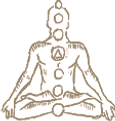
In terms of the chakras, this process of connecting to and expressing our inner child must begin at the root, the center of safety, trust, and fear. It is the ground on which we sit and later stand, the container for all development to come. As an infant develops, and lives in coddled safety, they soon move to the second chakra, the sacral, the place of emotions, movement, desire, and sensate exploration. In order to explore, we must have trust that we are safe and that we will not be shamed for our curiosity as we move to our third chakra, the solar plexus. Here we begin to transform our sense of self, our independence, and our power as individuals. The child will continue to move up through the chakras, on to the fourth, the heart, learning to craft relationships, social identity, and how to love; then to the fifth, the throat, where they will learn to express themselves verbally, to be creative and opinionated; on upward to the sixth and seventh chakras, the third eye and the crown, where they will see more thoroughly into the lives of others and the truth of the world.
For my own inner child I see that something changes beginning at the heart chakra. Openness and connection are great when they’re great, but I feel that from here up is where we often begin to lose our inner child. We feel judged or out of place; we feel unable to express our truth as we are told that we are silly children, and we begin to see through the lies we were told about the world, our families, our dreams. The heart is the crux between our safe, curious, imaginative child, and our shaky, challenged path to adulthood. For the yogi looking to rediscover their sukham--thier sense of joy and ease, their “happy place”--I find it best to start from the safe root and work toward our loving heart. Free flow at the base will allow free flow to the top. In order to get there, though, we must grant ourselves permission to play.

The benefits of play are far and wide. From movement therapy to role play to tactile manipulation and artistic expression, modern psychology has discovered play therapy in adults to be one of the greatest modes of healing. It fosters creativity and mind-body integration, as well as increasing self-esteem and decreasing stress. According to the late child psychologist Donald Winnecott, “It is in playing and only in playing that the individual child or adult is able to be creative and to use the whole personality, and it is only in being creative the individual discovers the self.”
While we are often invited to “play around” in our yoga classes--mostly in regards to warming up our wrists, walking our down dogs, and maybe switch-kicking in our handstand preps--I feel there is space to re-think what we imagine to be “play” on the mat. Maybe it is learning to laugh at ourselves when we fall, or moving intuitively, dancing around and shaking out our limbs with smiles and strange sounds. Perhaps it is slithering out our tongues in cobra, mooing in our cows, and meowing in our cats. It could be imagining we are real warriors fighting evil, or real crows on a mission to deliver messages across the high seas. And maybe, just maybe, the little child inside of us will forget they have a job and bills and cellulite, forget they have to be working toward a goal, so then finally they can let go, be free. Yes, we must be strong, stable, and correct in our postures, but we must also be joyful and creative if we hope to truly discover our whole self, inner-child included.

Comments